Beschreibung
Dieses Tutorial zeigt, welche Primitive mit OpenGL gezeichnet werden können.
Platformen:
- Linux
- Cygwin
Download
Die auf dieser Seite aufgeführten Sourcecodes dürfen uneingeschränkt verwendet, kopiert, verändert und publiziert werden. Jegliche Haftung wird abgelehnt, die Verwendung des hier publizierten Materials geschieht auf eigenes Risiko.
Source: tutorial03.cpp
Paket: tutorial03.tgz
Build und Start
Linux:
Windows/Cygwin:
Das Demo
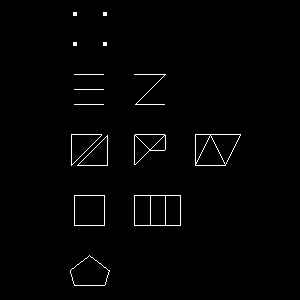
Dieses Demo zeigt alle möglichen Primitiven, die mit OpenGL gezeichnet werden können.
- A: Punkte:
GL_POINTS - B: Linien:
GL_LINES - C: Zusammenhängende Linie:
GL_LINE_STRIP - D: Dreiecke:
GL_TRIANGLES - E: Fächer:
GL_TRIANGLE_FAN - F: Band aus Dreiecken:
GL_TRIANGLE_STRIP - G: Rechtecke:
GL_QUADS - H: Band aus Rechtecken:
GL_QUAD_STRIP - I: Allgemeines Polygon:
GL_POLYGON
Das Programm
Die obligatorischen header files:
Zeichnet die Punkte (A):
void draw_points(void)
{
    glPushMatrix();
    glTranslatef(-1.0, +2.0, 0.0);
    glScalef(0.25, 0.25, 0.25);
    glPointSize(4.0);
    glColor4f(1.0, 1.0, 1.0, 1.0);
    glBegin(GL_POINTS);
        glVertex3f(-1.0, -1.0, 0.0);
        glVertex3f( 1.0, -1.0, 0.0);
        glVertex3f( 1.0,  1.0, 0.0);
        glVertex3f(-1.0,  1.0, 0.0);
    glEnd();
    glPopMatrix();
}
Zeichnet die Linien (B):
void draw_lines(void)
{
    glPushMatrix();
    glTranslatef(-1.0, +1.0, 0.0);
    glScalef(0.25, 0.25, 0.25);
    glColor4f(1.0, 1.0, 1.0, 1.0);
    glBegin(GL_LINES);
        glVertex3f(-1.0, +1.0, 0.0); glVertex3f(+1.0, +1.0, 0.0);
        glVertex3f(-1.0,  0.0, 0.0); glVertex3f(+1.0,  0.0, 0.0);
        glVertex3f(-1.0, -1.0, 0.0); glVertex3f(+1.0, -1.0, 0.0);
    glEnd();
    glPopMatrix();
}
Zeichnet die zusammenhängende Linie (C):
void draw_line_strip(void)
{
    glPushMatrix();
    glTranslatef( 0.0, +1.0, 0.0);
    glScalef(0.25, 0.25, 0.25);
    glColor4f(1.0, 1.0, 1.0, 1.0);
    glBegin(GL_LINE_STRIP);
        glVertex3f(-1.0, +1.0, 0.0);
        glVertex3f(+1.0, +1.0, 0.0);
        glVertex3f(-1.0, -1.0, 0.0);
        glVertex3f(+1.0, -1.0, 0.0);
    glEnd();
    glPopMatrix();
}
Zeichnet die Dreiecke (D):
void draw_triangles(void)
{
    glPushMatrix();
    glTranslatef(-1.0, 0.0, 0.0);
    glScalef(0.25, 0.25, 0.25);
    // triangle 1
    glTranslatef(-0.2, 0.0, 0.0);
    glColor4f(1.0, 1.0, 1.0, 1.0);
    glBegin(GL_TRIANGLES);
        glVertex3f(-1.0, -1.0, 0.0);
        glVertex3f(+1.0, +1.0, 0.0);
        glVertex3f(-1.0, +1.0, 0.0);
    glEnd();
    // triangle 2
    glTranslatef(0.4, 0.0, 0.0);
    glColor4f(1.0, 1.0, 1.0, 1.0);
    glBegin(GL_TRIANGLES);
        glVertex3f(-1.0, -1.0, 0.0);
        glVertex3f(+1.0, -1.0, 0.0);
        glVertex3f(+1.0, +1.0, 0.0);
    glEnd();
    glPopMatrix();
}
Zeichnet den Fächer (E):
void draw_triangle_fan(void)
{
    glPushMatrix();
    glTranslatef( 0.0, 0.0, 0.0);
    glScalef(0.25, 0.25, 0.25);
    glColor4f(1.0, 1.0, 1.0, 1.0);
    glBegin(GL_TRIANGLE_FAN);
        glVertex3f( 0.0,  0.0, 0.0);
        glVertex3f(+1.0,  0.0, 0.0);
        glVertex3f(+1.0, +1.0, 0.0);
        glVertex3f(-1.0, +1.0, 0.0);
        glVertex3f(-1.0, -1.0, 0.0);
    glEnd();
    glPopMatrix();
}
Zeichnet das Band aus Dreiecken (F):
void draw_triangle_strip(void)
{
    glPushMatrix();
    glTranslatef(1.0, 0.0, 0.0);
    glScalef(0.25, 0.25, 0.25);
    glColor4f(1.0, 1.0, 1.0, 1.0);
    glBegin(GL_TRIANGLE_STRIP);
        glVertex3f(-1.0, +1.0, 0.0);
        glVertex3f(-1.0, -1.0, 0.0);
        glVertex3f( 0.0, +1.0, 0.0);
        glVertex3f(+1.0, -1.0, 0.0);
        glVertex3f(+2.0, +1.0, 0.0);
    glEnd();
    glPopMatrix();
}
Zeichnet das Rechteck (G):
void draw_quads(void)
{
    glPushMatrix();
    glTranslatef(-1.0, -1.0, 0.0);
    glScalef(0.25, 0.25, 0.25);
    glColor4f(1.0, 1.0, 1.0, 1.0);
    glBegin(GL_QUADS);
        glVertex3f( 1.0,  1.0, 0.0);
        glVertex3f(-1.0,  1.0, 0.0);
        glVertex3f(-1.0, -1.0, 0.0);
        glVertex3f( 1.0, -1.0, 0.0);
    glEnd();
    glPopMatrix();
}
Zeichnet das Band aus Rechtecken (H):
void draw_quad_strip(void)
{
    glPushMatrix();
    glTranslatef( 0.0, -1.0, 0.0);
    glScalef(0.25, 0.25, 0.25);
    glColor4f(1.0, 1.0, 1.0, 1.0);
    glBegin(GL_QUAD_STRIP);
        glVertex3f(-1.0, +1.0, 0.0);
        glVertex3f(-1.0, -1.0, 0.0);
        glVertex3f( 0.0, +1.0, 0.0);
        glVertex3f( 0.0, -1.0, 0.0);
        glVertex3f(+1.0, +1.0, 0.0);
        glVertex3f(+1.0, -1.0, 0.0);
        glVertex3f(+2.0, +1.0, 0.0);
        glVertex3f(+2.0, -1.0, 0.0);
    glEnd();
    glPopMatrix();
}
Zeichnet das allgemeine Polygon (I):
void draw_polygon(void)
{
    glPushMatrix();
    glTranslatef(-1.0, -2.0, 0.0);
    glScalef(0.25, 0.25, 0.25);
    glColor4f(1.0, 1.0, 1.0, 1.0);
    glBegin(GL_POLYGON);
        glVertex3f(-1.0, -1.0, 0.0);
        glVertex3f(+1.0, -1.0, 0.0);
        glVertex3f(+1.3,  0.0, 0.0);
        glVertex3f( 0.0, +1.0, 0.0);
        glVertex3f(-1.3,  0.0, 0.0);
    glEnd();
    glPopMatrix();
}
Die Zeichnungsfunktion enthält nichts Ausgewöhnliches, was wir nicht schon kennen.
void display(void)
{
    glClear(GL_COLOR_BUFFER_BIT | GL_DEPTH_BUFFER_BIT);
    glPolygonMode(GL_FRONT_AND_BACK, GL_LINE);
    glLoadIdentity();

    gluLookAt(
        0.0,  0.0,  6.0,
        0.0,  0.0,  0.0,
        0.0,  1.0,  0.0);

    draw_points();
    draw_lines();
    draw_line_strip();
    draw_triangles();
    draw_triangle_fan();
    draw_triangle_strip();
    draw_quads();
    draw_quad_strip();
    draw_polygon();

    glFlush();
    glutSwapBuffers();
}
Auch die reshape Funktion ist nichts Spektakuläres:
void reshape(int w, int h)
{
    // prevent division by 0
    if (h == 0) h = 1;

    // define viewport
    glViewport(0, 0, w, h);

    // configuration of projection matrix
    glMatrixMode(GL_PROJECTION);
    glLoadIdentity();
    gluPerspective(45.0, (GLfloat)w / (GLfloat)h, 1.0, 100.0);

    // configuration of model view matrix
    glMatrixMode(GL_MODELVIEW);
}
Die Funktion main enhält die Initialisierung wie gewohnt:
int main(int argc, char ** argv)
{
    // general initialisation
    glutInit(&argc, argv);
    glutInitWindowSize(300, 300);
    glutInitWindowPosition(0, 0);
    glutInitDisplayMode(GLUT_RGBA | GLUT_DOUBLE | GLUT_DEPTH | GLUT_ALPHA);
    glutCreateWindow("OpenGL Demo 3");
    glutDisplayFunc(display);
    glutReshapeFunc(reshape);

    // configuration
    glClearColor(0.0, 0.0, 0.0, 0.0);
    glEnable(GL_DEPTH_TEST);
    glDepthFunc(GL_LESS);

    // go
    glutMainLoop();
    return 0;
}